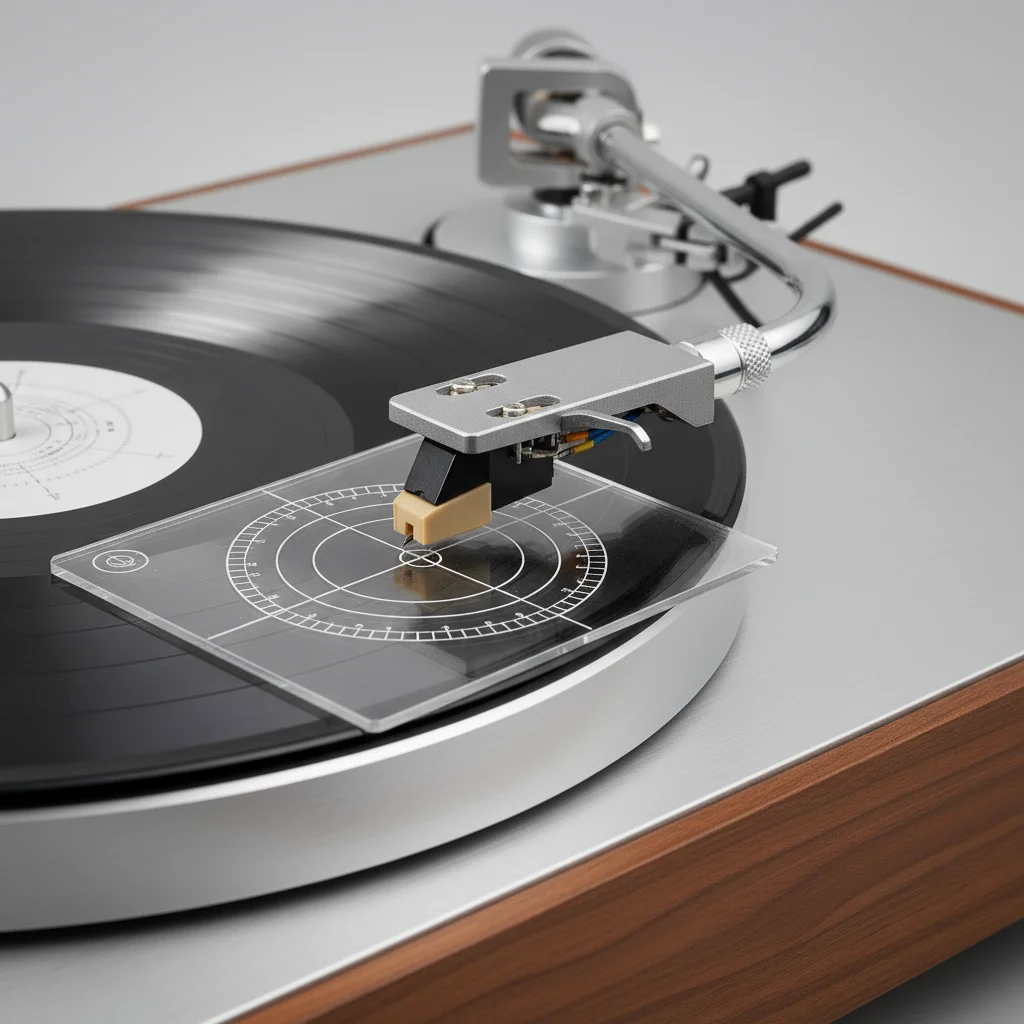
Record player cartridge alignment is crucial for achieving optimal sound quality and preventing damage to your vinyl records. Improper alignment can lead to distorted audio, premature record wear, and even stylus damage. There are three primary methods for aligning your cartridge: the Baerwald, Stevenson, and Loefgren B alignments, each offering distinct advantages depending on your tonearm’s geometry and listening preferences.
Understanding Cartridge Alignment Basics
Cartridge alignment refers to positioning the stylus precisely in the record groove. This involves adjusting the cartridge’s overhang and offset angle. Overhang is the distance the stylus extends beyond the spindle when the tonearm is pivoted over it, while the offset angle ensures the stylus tracks the groove at the correct angle across the entire record. Correct alignment minimizes tracking error, which is the deviation of the stylus from a perfect tangent to the record groove.
When the tracking error is minimized, the stylus can accurately read the modulations in the groove, resulting in a clearer, more detailed sound. Conversely, significant tracking error can cause the stylus to push against the groove walls unevenly, leading to sibilance, harshness, and a lack of stereo separation. It also increases friction and wear on both the stylus and your precious vinyl collection.
The Three Main Alignment Geometries
Each alignment geometry aims to minimize tracking error across different parts of the record. The Baerwald alignment prioritizes minimizing distortion across the entire record side, making it a popular choice for many audiophiles. It typically results in two null points (points where tracking error is zero) that are further apart, offering a good balance of performance.
The Stevenson alignment, on the other hand, focuses on minimizing distortion at the innermost grooves. This can be particularly beneficial for records that are cut close to the label, as it reduces the likelihood of inner-groove distortion, which is often more noticeable. The Loefgren B alignment offers a compromise between Baerwald and Stevenson, aiming for lower overall average distortion.
Tools and Process for Accurate Alignment
|
Our Picks for the Best Record Player in 2026
As an Amazon Associate I earn from qualifying purchases.
|
||
| Num | Product | Action |
|---|---|---|
| 1 | Vinyl Record Player Turntable with Built-in Bluetooth Receiver & 2 Stereo Speakers, 3 Speed 3 Size Portable Retro Record Player for Entertainment and Home Decoration |

|
| 2 | Vinyl Record Player with Dual Stereo Bookshelf Speakers Vintage Turntable with Bluetooth Wireless Playback Belt Drive 3-Speed Playback Record Player Support RCA Out Auto Stop |
|
| 3 | Victrola The Quincy 6-in-1 Bluetooth Record Player & Multimedia Center with Built-in Speakers – 3-Speed Turntable, CD & Cassette Player, AM/FM Radio, Wireless Music Streaming (Mahogony) |
|
| 4 | Victrola Journey Bluetooth Portable Suitcase Record Player – with Built-in Speakers, 3 Speed Vinyl Record Player, RCA Out, Headphone Jack (Smoky Blue) |
|
| 5 | Vintage Record Player with External Speakers Belt-Drive Turntable for Vinyl Records Dual Stereo Speakers LP Players Support 3 Speed 3 Size Wireless Playback AUX Headphone Input Auto Stop Wood Red |
|
| 6 | Vinyl Record Player with Speakers Vintage Turntable for Vinyls Records Belt-Driven Turn Table Support 3-Speed, Wireless Playback, Headphone, AUX-in, RCA Line LP Phonograph for Sound Enjoyment Black |
|
| 7 | Vinyl Record Player 3-Speed Bluetooth Suitcase Portable Belt-Driven Record Player with Built-in Speakers RCA Line Out AUX in Headphone Jack Vintage Turntable |
|
| 8 | Audio-Technica AT-LP60X-BK Fully Automatic Belt-Drive Stereo Turntable, Black, Hi-Fi, 2 Speed, Dust Cover, Anti-Resonance, Die-Cast Aluminum Platter |
|
| 9 | SoulBox S1 Vinyl Record Player with Stereo Speakers, Turntable with Built-in Preamp, S-Shaped Tonearm, 33/45 RPM - Walnut |
|
| 10 | Audio-Technica AT-LP60X-GM Fully Automatic Belt-Drive Stereo Turntable, Gunmetal/Black, Hi-Fidelity, Plays 33-1/3 and 45 RPM Vinyl Records, Dust Cover, Anti-Resonance, Die-Cast Aluminum Platter |
|
To accurately align your record player cartridge, you will need a few essential tools. The most important is an alignment protractor, which can be a simple paper protractor or a more sophisticated mirrored version. You’ll also need a small screwdriver or hex key for adjusting the cartridge screws, and a good light source to clearly see the stylus. Some enthusiasts also use a digital stylus force gauge to ensure the correct tracking force after alignment.
The general process involves placing the protractor on your turntable platter, ensuring it’s centered on the spindle. Then, you carefully move the tonearm to the designated null points on the protractor. At each null point, you adjust the cartridge’s position in the headshell until the stylus tip perfectly aligns with the grid lines on the protractor. This often requires small, iterative adjustments to both the overhang and the angle.
- Ensure your turntable is level before starting.
- Use a bright light to clearly see the stylus tip.
- Make small, precise adjustments to the cartridge.
- Check alignment at both null points on the protractor.
- Re-check tracking force after making adjustments.
Benefits of Proper Cartridge Alignment
The benefits of proper cartridge alignment are immediately audible. You’ll notice a significant improvement in sound clarity, with better stereo imaging and a more defined soundstage. Vocals will sound more natural, and instruments will have greater separation. Furthermore, proper alignment extends the life of both your stylus and your vinyl records by reducing unnecessary wear and tear.
Beyond the sonic improvements, correctly aligning your cartridge provides peace of mind, knowing that your valuable record collection is being treated with care. It’s a fundamental aspect of turntable setup that, once mastered, will elevate your listening experience considerably. Consider investing in a high-quality alignment protractor for the best results.
When to Re-Align Your Cartridge
It’s not a set-it-and-forget-it process. You should re-align your cartridge whenever you install a new cartridge or stylus. Additionally, if you notice any degradation in sound quality, such as increased distortion or sibilance, it’s a good idea to check your alignment. Moving your turntable or making other adjustments to your setup can also subtly shift the cartridge’s position, warranting a re-check.
Even if you haven’t made any changes, a periodic check every six months to a year is recommended to ensure everything remains optimal. Environmental factors like temperature changes can cause slight shifts over time. Taking the time to maintain proper alignment is a small effort that yields significant rewards in sound quality and equipment longevity.
