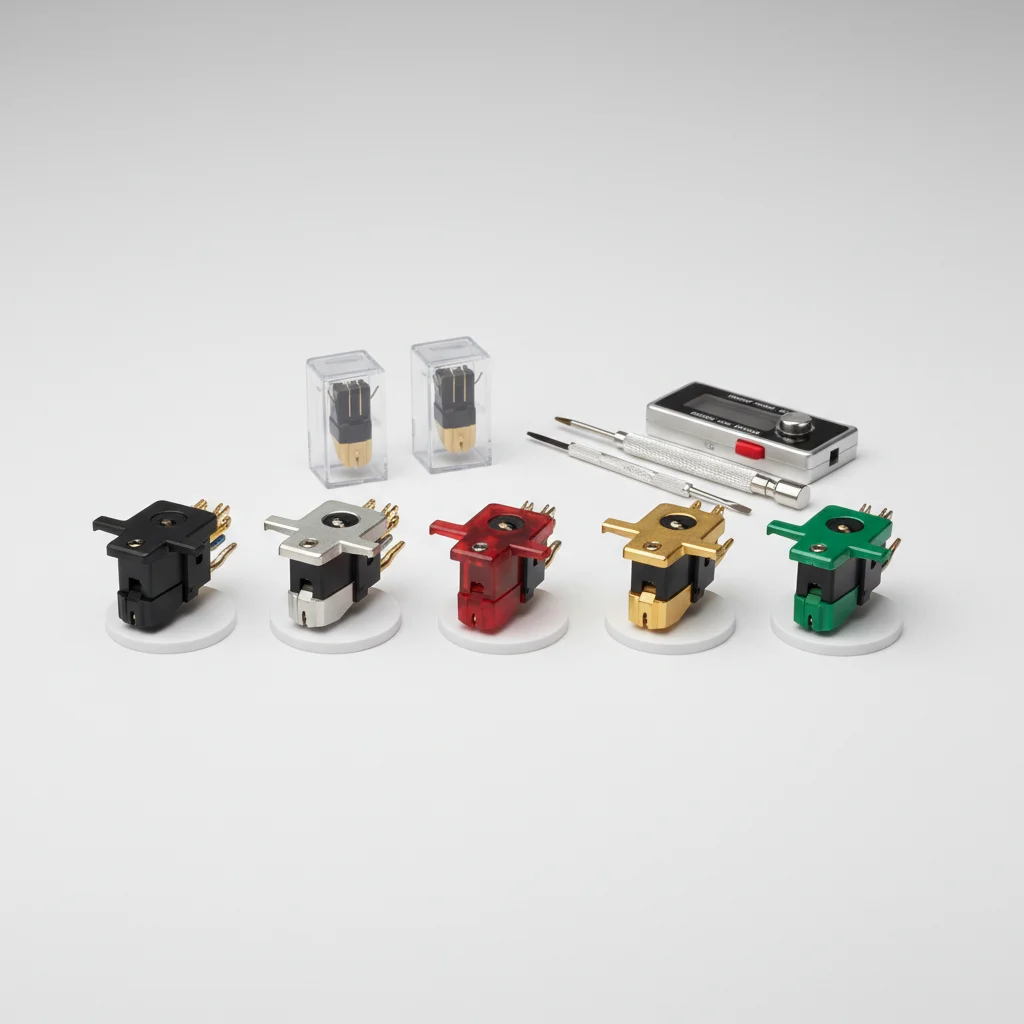
Upgrading your record player cartridge is one of the most impactful ways to improve sound quality, with five key factors to consider: cartridge type, specifications, stylus profile, tonearm/preamp matching, and installation. A new cartridge can dramatically enhance clarity, detail, and bass response, making your vinyl collection sound better than ever.
Understanding Cartridge Types
There are two primary types of phono cartridges: Moving Magnet (MM) and Moving Coil (MC). Moving Magnet cartridges are generally more affordable, offering higher output (2.5mV to 7mV) and compatibility with a wider range of phono preamps. Their styli are often user-replaceable, making them a great starting point for many audiophiles seeking a significant upgrade without breaking the bank.
Moving Coil cartridges are typically more expensive and produce a lower output (0.1mV to 2.5mV), often requiring a specialized MC phono preamp. They are renowned for superior detail retrieval, wider frequency response, and a more nuanced soundstage. While the stylus on most MC cartridges is not user-replaceable, requiring the entire cartridge to be sent for retipping or replacement, their sonic benefits can be substantial for serious listeners.
Key Specifications to Consider
When evaluating cartridges, several specifications are crucial. Output voltage, measured in millivolts (mV), determines the signal strength. Compliance, measured in µm/mN, refers to the stylus’s flexibility and its ability to track the record groove. Matching compliance with your tonearm’s effective mass is important for optimal performance and to prevent mistracking or resonance issues. Tracking force, specified in grams, is the downward pressure required for the stylus to properly sit in the groove.
Stylus Profiles and Their Impact
The shape of the stylus, or needle, significantly affects sound quality and record wear. Common stylus profiles include conical, elliptical, and various line contact designs. Conical styli are the simplest and most affordable, offering good all-around performance. Elliptical styli have a smaller contact area with the groove walls, leading to improved high-frequency response and better tracking. Line contact styli, such as Shibata, MicroLine, or Fine Line, offer the most precise groove tracing, resulting in exceptional detail, reduced inner groove distortion, and extended frequency response. These advanced profiles also tend to cause less record wear due to their larger contact area spread over the groove wall.
Matching Cartridge to Tonearm and Preamp
|
Our Picks for the Best Record Player in 2026
As an Amazon Associate I earn from qualifying purchases.
|
||
| Num | Product | Action |
|---|---|---|
| 1 | Victrola The Quincy 6-in-1 Bluetooth Record Player & Multimedia Center with Built-in Speakers – 3-Speed Turntable, CD & Cassette Player, AM/FM Radio, Wireless Music Streaming (Mahogony) |

|
| 2 | Vinyl Record Player with Speakers Vintage Turntable for Vinyls Records Belt-Driven Turn Table Support 3-Speed, Wireless Playback, Headphone, AUX-in, RCA Line LP Phonograph for Sound Enjoyment Black |
|
| 3 | Audio-Technica AT-LP60X-BK Fully Automatic Belt-Drive Stereo Turntable, Black, Hi-Fi, 2 Speed, Dust Cover, Anti-Resonance, Die-Cast Aluminum Platter |
|
| 4 | Vinyl Record Player 3-Speed Bluetooth Suitcase Portable Belt-Driven Record Player with Built-in Speakers RCA Line Out AUX in Headphone Jack Vintage Turntable |
|
| 5 | Vinyl Record Player with Dual Stereo Bookshelf Speakers Vintage Turntable with Bluetooth Wireless Playback Belt Drive 3-Speed Playback Record Player Support RCA Out Auto Stop |
|
| 6 | SoulBox S1 Vinyl Record Player with Stereo Speakers, Turntable with Built-in Preamp, S-Shaped Tonearm, 33/45 RPM - Walnut |
|
| 7 | Vinyl Record Player Turntable with Built-in Bluetooth Receiver & 2 Stereo Speakers, 3 Speed 3 Size Portable Retro Record Player for Entertainment and Home Decoration |
|
| 8 | Vintage Record Player with External Speakers Belt-Drive Turntable for Vinyl Records Dual Stereo Speakers LP Players Support 3 Speed 3 Size Wireless Playback AUX Headphone Input Auto Stop Wood Red |
|
| 9 | Audio-Technica AT-LP60X-GM Fully Automatic Belt-Drive Stereo Turntable, Gunmetal/Black, Hi-Fidelity, Plays 33-1/3 and 45 RPM Vinyl Records, Dust Cover, Anti-Resonance, Die-Cast Aluminum Platter |
|
| 10 | Victrola Journey Bluetooth Portable Suitcase Record Player – with Built-in Speakers, 3 Speed Vinyl Record Player, RCA Out, Headphone Jack (Smoky Blue) |
|
Proper synergy between your cartridge, tonearm, and phono preamp is vital for achieving the best sound. A heavy tonearm generally pairs well with a low-compliance cartridge, while a light tonearm is better suited for a high-compliance cartridge. Your phono preamp must also be compatible with your chosen cartridge type (MM or MC) and provide adequate gain. Many modern preamps offer switchable gain settings to accommodate both types. Consulting your turntable’s manual for tonearm specifications and your preamp’s manual for input compatibility is highly recommended before making a purchase.
Installation and Alignment Tips
Installing a new cartridge requires precision and patience. The process involves mounting the cartridge to the headshell, connecting the tiny color-coded wires, and then carefully aligning the cartridge. Proper alignment ensures the stylus tracks the groove correctly, minimizing distortion and maximizing sound quality. Tools like an alignment protractor, a tracking force gauge, and a small jeweler’s screwdriver are essential. If you’re new to cartridge installation, watching online tutorials or seeking assistance from an experienced technician can be very helpful. Incorrect alignment can lead to poor sound and accelerated record wear.
- Always power off your turntable before beginning installation.
- Use a non-magnetic screwdriver to avoid damaging the cartridge.
- Double-check all wiring connections for correct polarity.
- Set tracking force precisely using a digital gauge.
- Perform a final alignment check with a protractor.
Top Cartridge Upgrade Options
When considering an upgrade, there are many excellent options across various price points. For those looking for a significant step up from an entry-level cartridge, the Audio-Technica VM95ML offers an exceptional MicroLine stylus at an accessible price, providing detailed and accurate sound. Another popular choice for its balanced performance and robust build is the Ortofon 2M Blue, an elliptical MM cartridge that delivers vibrant and engaging audio. For audiophiles venturing into Moving Coil territory, the Denon DL-103 remains a classic, known for its warm and musical presentation, while the Hana EL offers a more modern, detailed sound.These cartridges represent some of the best value and performance in their respective categories, offering noticeable improvements over stock cartridges.
Ultimately, the best record player cartridge upgrade depends on your budget, your existing equipment, and your personal sonic preferences. By understanding the different types, specifications, and installation nuances, you can make an informed decision that will bring new life to your vinyl collection. Experimentation and careful listening are key to finding the perfect match for your system.
Frequently Asked Questions
What are the main types of record player cartridges?
The main types of record player cartridges are Moving Magnet (MM) and Moving Coil (MC). MM cartridges are generally more affordable with higher output, while MC cartridges offer superior detail but require specialized preamps and are more expensive.
How does stylus profile affect sound quality and record wear?
Stylus profiles like conical, elliptical, and line contact significantly impact sound. Line contact styli (e.g., MicroLine) offer the most precise groove tracing, resulting in exceptional detail and reduced inner groove distortion, while also causing less record wear due to a larger contact area.
What specifications are important when choosing a new cartridge?
Key specifications include output voltage (measured in mV), which indicates signal strength; compliance (u00b5m/mN), which relates to stylus flexibility; and tracking force (grams), the downward pressure needed for proper groove tracking. Matching compliance to your tonearm's effective mass is crucial.
Is it difficult to install a new record player cartridge?
Installing a new record player cartridge requires precision and patience, involving mounting, wiring, and careful alignment. Essential tools include an alignment protractor and a tracking force gauge. Incorrect installation can lead to poor sound and accelerated record wear.
Which cartridge brands are recommended for an upgrade?
For MM upgrades, the Audio-Technica VM95ML with its MicroLine stylus and the Ortofon 2M Blue elliptical cartridge are popular choices. For MC options, the Denon DL-103 offers a warm sound, while the Hana EL provides a more modern, detailed presentation.
How to Install and Align a Record Player Cartridge
Properly installing and aligning a new record player cartridge is crucial for optimal sound quality and to prevent damage to your records. This process requires precision and specific tools.
Always power off your turntable before starting any installation. Ensure the tonearm is secured and you have a clean, well-lit workspace. Gather all necessary tools like a non-magnetic screwdriver, tracking force gauge, and alignment protractor.
Carefully mount the new cartridge to the headshell using a non-magnetic screwdriver to avoid damaging the cartridge. Connect the tiny, color-coded wires from the tonearm to the corresponding pins on the cartridge, ensuring correct polarity for each connection.
Once the cartridge is mounted and wired, use a digital tracking force gauge to precisely set the recommended downward pressure. Refer to your cartridge's specifications for the exact tracking force range. Incorrect tracking force can lead to mistracking and record wear.
Use an alignment protractor to carefully align the cartridge. This ensures the stylus tracks the record groove correctly across the entire record, minimizing distortion. Adjust the cartridge position in the headshell until it aligns perfectly with the protractor's grid points.
Double-check all connections and settings. Power on your turntable and test the sound with a familiar record. Listen for any distortion or tracking issues. If you encounter problems, re-verify your tracking force and alignment.

I was hoping for a bigger jump in bass response after upgrading my cartridge, but it’s only a subtle improvement. The guide on cartridge types was good, and I opted for a higher-output MM cartridge for ease of use. Maybe my expectations were too high, or I need to look at other components next. It’s decent, but not the dramatic change I anticipated.
I appreciated the breakdown of stylus profiles; I never realized how much that impacted the sound. I ended up choosing a microlinear stylus, and the detail it pulls out of my jazz albums is incredible. Installation was a bit fiddly, but taking my time paid off. My only minor gripe is that it took a while to really break in.
This really helped me understand the specifications to look for. I was always confused by output voltage and compliance. After reading this, I felt confident picking out a new Moving Coil cartridge, even though they’re pricier. The soundstage is so much wider now, and the quiet passages are incredibly clean. My classical records have never sounded better.
I’ve been wanting to upgrade my setup for a while, and the advice on matching the tonearm and preamp was super helpful. I went with a new Moving Magnet cartridge, and the difference in clarity is night and day. My old records sound brand new. Definitely worth the investment for anyone serious about their vinyl.