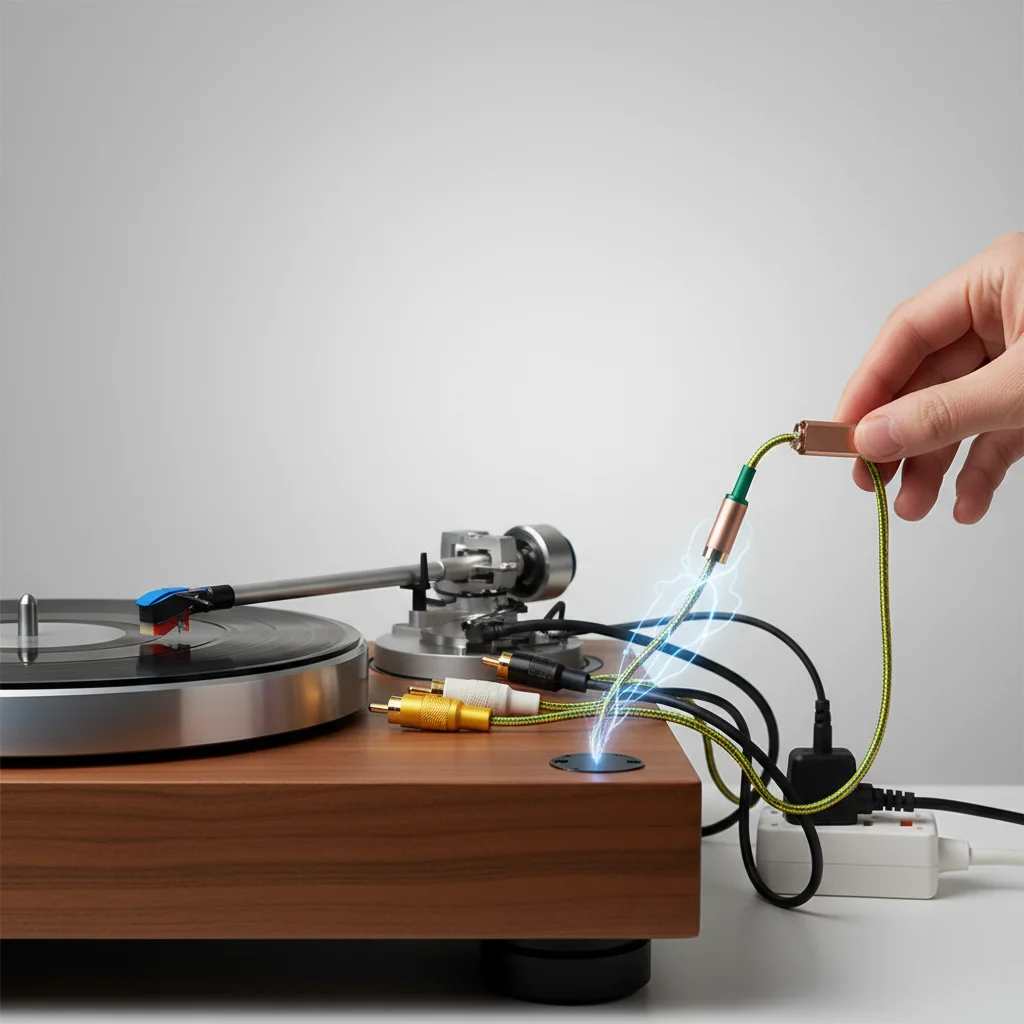
A record player ground loop is a common audio issue that manifests as a persistent, low-frequency hum or buzz, significantly detracting from your listening experience. This problem typically arises when there are multiple ground paths in your audio system, creating an unintended circuit that picks up electrical interference. Eliminating a ground loop usually involves identifying and breaking these redundant paths, often through strategic cable management, using isolation transformers, or ensuring all components share a single, clean ground point. There are typically five main strategies to effectively resolve this issue.
Understanding the Ground Loop Phenomenon
A ground loop occurs when two or more pieces of audio equipment are connected to different ground points, or when a single piece of equipment has multiple ground connections. Electricity, always seeking the path of least resistance, will flow through these multiple ground paths, creating a loop. This loop acts like an antenna, picking up stray electromagnetic interference (EMI) from household wiring, appliances, and even radio frequencies. The result is an audible hum that can range from a subtle buzz to a loud, intrusive drone, directly impacting the clarity and enjoyment of your vinyl playback.
Identifying the source of a ground loop can sometimes be a process of elimination. It’s crucial to understand that not all hums are ground loops; some can be caused by faulty cables, unshielded components, or even issues with the turntable’s internal wiring. However, a persistent hum that changes in intensity when you connect or disconnect certain components is a strong indicator of a ground loop.
Isolating the Problematic Components
The first step in resolving a ground loop is to isolate the components involved. Begin by disconnecting all audio components from your record player system except for the turntable itself and the amplifier/receiver. If the hum persists, the issue might be internal to the turntable or amplifier. If the hum disappears, gradually reintroduce each component one by one, listening for the return of the hum. The component that causes the hum to reappear is likely part of the ground loop. This methodical approach helps pinpoint the exact connection or device that is creating the redundant ground path.
Pay close attention to how components are powered. If your turntable, preamp, and amplifier are all plugged into different wall outlets, they might be referencing different ground potentials, which is a classic setup for a ground loop. Consolidating power to a single, high-quality power strip can often resolve this by ensuring all components share a common ground reference.
Utilizing Ground Loop Isolators
|
Our Picks for the Best Record Player in 2026
As an Amazon Associate I earn from qualifying purchases.
|
||
| Num | Product | Action |
|---|---|---|
| 1 | Vintage Record Player with External Speakers Belt-Drive Turntable for Vinyl Records Dual Stereo Speakers LP Players Support 3 Speed 3 Size Wireless Playback AUX Headphone Input Auto Stop Wood Red |

|
| 2 | Vinyl Record Player Turntable with Built-in Bluetooth Receiver & 2 Stereo Speakers, 3 Speed 3 Size Portable Retro Record Player for Entertainment and Home Decoration |
|
| 3 | Vinyl Record Player 3-Speed Bluetooth Suitcase Portable Belt-Driven Record Player with Built-in Speakers RCA Line Out AUX in Headphone Jack Vintage Turntable |
|
| 4 | SoulBox S1 Vinyl Record Player with Stereo Speakers, Turntable with Built-in Preamp, S-Shaped Tonearm, 33/45 RPM - Walnut |
|
| 5 | Audio-Technica AT-LP60X-GM Fully Automatic Belt-Drive Stereo Turntable, Gunmetal/Black, Hi-Fidelity, Plays 33-1/3 and 45 RPM Vinyl Records, Dust Cover, Anti-Resonance, Die-Cast Aluminum Platter |
|
| 6 | Audio-Technica AT-LP60X-BK Fully Automatic Belt-Drive Stereo Turntable, Black, Hi-Fi, 2 Speed, Dust Cover, Anti-Resonance, Die-Cast Aluminum Platter |
|
| 7 | Victrola Journey Bluetooth Portable Suitcase Record Player – with Built-in Speakers, 3 Speed Vinyl Record Player, RCA Out, Headphone Jack (Smoky Blue) |
|
| 8 | Victrola The Quincy 6-in-1 Bluetooth Record Player & Multimedia Center with Built-in Speakers – 3-Speed Turntable, CD & Cassette Player, AM/FM Radio, Wireless Music Streaming (Mahogony) |
|
| 9 | Vinyl Record Player with Dual Stereo Bookshelf Speakers Vintage Turntable with Bluetooth Wireless Playback Belt Drive 3-Speed Playback Record Player Support RCA Out Auto Stop |
|
| 10 | Vinyl Record Player with Speakers Vintage Turntable for Vinyls Records Belt-Driven Turn Table Support 3-Speed, Wireless Playback, Headphone, AUX-in, RCA Line LP Phonograph for Sound Enjoyment Black |
|
Ground loop isolators are passive devices designed to break the electrical connection between two pieces of equipment while still allowing the audio signal to pass through. These devices typically use transformers to achieve this isolation. They are particularly effective when the ground loop is occurring between two specific components, such as your turntable and your phono preamp, or between your preamp and your amplifier. Simply insert the isolator into the audio signal path between the two problematic components.
- Choose an isolator with high-quality components to avoid signal degradation.
- Ensure the isolator is compatible with your audio connections (RCA, XLR, etc.).
- Test the isolator in different parts of your signal chain to find the most effective placement.
- Consider a balanced power conditioner for more complex systems.
- Avoid cheap, unbranded isolators that may introduce their own noise.
While effective, ground loop isolators should be seen as a solution for specific problem areas rather than a blanket fix for an entire system. Overuse can sometimes lead to subtle changes in sound quality, so use them judiciously where they are most needed.
Proper Cable Management and Shielding
Poor cable management can contribute to ground loops and other forms of interference. Ensure that your audio cables are not running parallel to power cables, as this can induce hum. Use shielded audio cables, which are designed to protect the internal signal wires from external electromagnetic interference. High-quality shielded cables have a braided or foil shield that is connected to the ground, effectively shunting any induced noise away from the audio signal.
Additionally, check the condition of all your cables. Frayed or damaged cables can create intermittent connections or expose unshielded wires, making your system more susceptible to noise. Replace any suspect cables. Sometimes, simply rerouting cables to create more distance between power and audio lines can make a significant difference in reducing hum.
Ensuring a Single Ground Point
The ideal scenario for any audio system is to have a single, common ground point for all components. This prevents the creation of multiple ground paths. If your turntable has a separate ground wire, ensure it is securely connected to the ground terminal on your phono preamp or amplifier. If your amplifier has a dedicated ground lug, use it. Avoid connecting ground wires to multiple points, as this can inadvertently create a ground loop.
In some cases, especially with older homes or complex electrical setups, you might need to consult an electrician to ensure your wall outlets are properly grounded and that there isn’t an underlying electrical issue contributing to the problem. A clean, consistent ground reference throughout your entire audio chain is paramount for a hum-free listening experience.

I tried all five strategies mentioned, including making sure all my components shared a single ground point, but I’m still getting a noticeable hum. It’s less pronounced than it was, but not completely gone. Maybe my issue is more complex, or I need a different type of solution. Good info, just didn’t fully solve my specific problem.
I was getting so frustrated with the constant hum from my turntable, especially during quiet passages. The advice here about strategic cable management and checking all my connections really made a difference. My setup sounds so much cleaner now, it’s like I have a whole new system. Definitely recommend trying these tips if you’re dealing with that annoying buzz.
This was a lifesaver! My new record player had this persistent low-frequency hum that was driving me crazy. Following the steps to identify and break the redundant ground paths completely eliminated it. I can finally enjoy my records without that distracting background noise. So glad I found this information.
The explanation of how a ground loop actually happens was super helpful. I always just thought it was bad wiring. I ended up trying an isolation transformer as suggested, and it cleared up about 80% of the hum. Still a tiny bit there, but it’s way better than before. Worth the investment for sure.