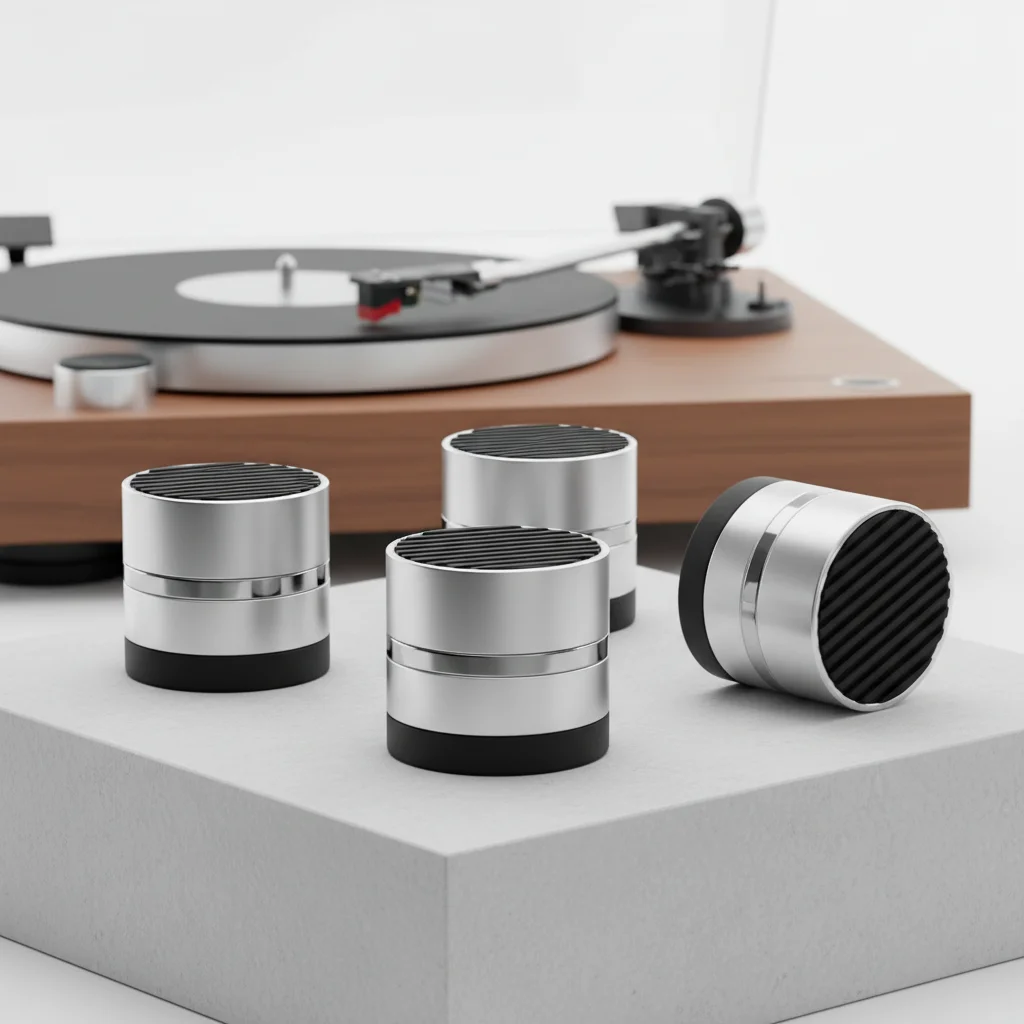
Record player isolation feet can significantly improve sound quality by reducing unwanted vibrations that interfere with playback. While the degree of improvement varies depending on your existing setup and listening environment, many audiophiles report a noticeable enhancement in clarity, detail, and bass response. These specialized feet work by decoupling the turntable from the surface it rests on, minimizing the transfer of external vibrations and internal motor noise.
Understanding Vibration and Its Impact on Turntables
Vibrations are the arch-nemesis of high-fidelity audio, especially for record players. Even subtle tremors from footfalls, speakers, or even the turntable’s own motor can be transmitted through the plinth and into the stylus. When the stylus encounters these unwanted vibrations, it misreads the grooves of the record, leading to distorted sound, reduced clarity, and a muddied soundstage. This phenomenon is often more pronounced in setups where the turntable is placed on a less stable surface or in close proximity to speakers.
The goal of isolation is to create a barrier that prevents these disruptive forces from reaching the sensitive components of your record player. Effective isolation allows the stylus to track the record’s grooves with greater precision, revealing more of the music’s intended detail and dynamic range. It’s a crucial step for anyone looking to optimize their analog listening experience.
Types of Record Player Isolation Feet
There are several types of isolation feet available, each employing different principles to combat vibrations. Common designs include rubber or Sorbothane feet, which absorb vibrations through their compliant material. Spring-loaded feet use a suspension system to decouple the turntable, while magnetic levitation feet offer an almost frictionless separation. Some high-end options combine multiple materials and designs for maximum effectiveness.
Choosing the right type often depends on the specific vibrations you’re trying to mitigate and your budget. For general room vibrations, simple rubber or Sorbothane pads can offer a good starting point. For more severe issues, such as heavy foot traffic or powerful subwoofers, more advanced spring or magnetic systems might be necessary. Consider the weight of your turntable when selecting feet, as they are often rated for specific load capacities.
- Sorbothane pads for broad vibration absorption.
- Spring-loaded feet for mechanical decoupling.
- Magnetic levitation feet for advanced isolation.
- Adjustable height feet for leveling and stability.
- Hybrid designs combining materials for optimal performance.
Installation and Setup Considerations
|
Our Picks for the Best Record Player in 2026
As an Amazon Associate I earn from qualifying purchases.
|
||
| Num | Product | Action |
|---|---|---|
| 1 | Vinyl Record Player with Speakers Vintage Turntable for Vinyls Records Belt-Driven Turn Table Support 3-Speed, Wireless Playback, Headphone, AUX-in, RCA Line LP Phonograph for Sound Enjoyment Black |

|
| 2 | Vintage Record Player with External Speakers Belt-Drive Turntable for Vinyl Records Dual Stereo Speakers LP Players Support 3 Speed 3 Size Wireless Playback AUX Headphone Input Auto Stop Wood Red |
|
| 3 | SoulBox S1 Vinyl Record Player with Stereo Speakers, Turntable with Built-in Preamp, S-Shaped Tonearm, 33/45 RPM - Walnut |
|
| 4 | Vinyl Record Player with Dual Stereo Bookshelf Speakers Vintage Turntable with Bluetooth Wireless Playback Belt Drive 3-Speed Playback Record Player Support RCA Out Auto Stop |
|
| 5 | Victrola Journey Bluetooth Portable Suitcase Record Player – with Built-in Speakers, 3 Speed Vinyl Record Player, RCA Out, Headphone Jack (Smoky Blue) |
|
| 6 | Audio-Technica AT-LP60X-BK Fully Automatic Belt-Drive Stereo Turntable, Black, Hi-Fi, 2 Speed, Dust Cover, Anti-Resonance, Die-Cast Aluminum Platter |
|
| 7 | Victrola The Quincy 6-in-1 Bluetooth Record Player & Multimedia Center with Built-in Speakers – 3-Speed Turntable, CD & Cassette Player, AM/FM Radio, Wireless Music Streaming (Mahogony) |
|
| 8 | Audio-Technica AT-LP60X-GM Fully Automatic Belt-Drive Stereo Turntable, Gunmetal/Black, Hi-Fidelity, Plays 33-1/3 and 45 RPM Vinyl Records, Dust Cover, Anti-Resonance, Die-Cast Aluminum Platter |
|
| 9 | Vinyl Record Player Turntable with Built-in Bluetooth Receiver & 2 Stereo Speakers, 3 Speed 3 Size Portable Retro Record Player for Entertainment and Home Decoration |
|
| 10 | Vinyl Record Player 3-Speed Bluetooth Suitcase Portable Belt-Driven Record Player with Built-in Speakers RCA Line Out AUX in Headphone Jack Vintage Turntable |
|
Installing record player isolation feet is typically a straightforward process. Most feet simply replace the existing ones on your turntable, often screwing into the plinth or resting directly underneath. It’s important to ensure that the turntable remains perfectly level after installation, as an unlevel platter can lead to tracking errors and uneven wear on your records and stylus. Many isolation feet offer height adjustment for this purpose.
Beyond the feet themselves, consider the surface your turntable rests on. A heavy, rigid surface like a dedicated audio rack or a wall-mounted shelf will provide a better foundation than a flimsy table. Combining quality isolation feet with a stable support structure creates the most effective defense against vibrations, allowing your record player to perform at its best.
The Audible Difference: What to Expect
When properly implemented, record player isolation feet can yield a noticeable improvement in sound quality. Listeners often report a tighter, more defined bass response, as muddiness caused by vibrations is reduced. Midrange frequencies can become clearer, and high frequencies may exhibit greater sparkle and detail. The overall soundstage can also expand, creating a more immersive and engaging listening experience.
While the change might not be as dramatic as upgrading a cartridge or amplifier, it’s a refinement that serious audiophiles appreciate. The subtle nuances of your favorite recordings become more apparent, and the background noise floor can drop, allowing the music to emerge with greater presence. It’s an investment in optimizing the signal path from your record to your ears.
