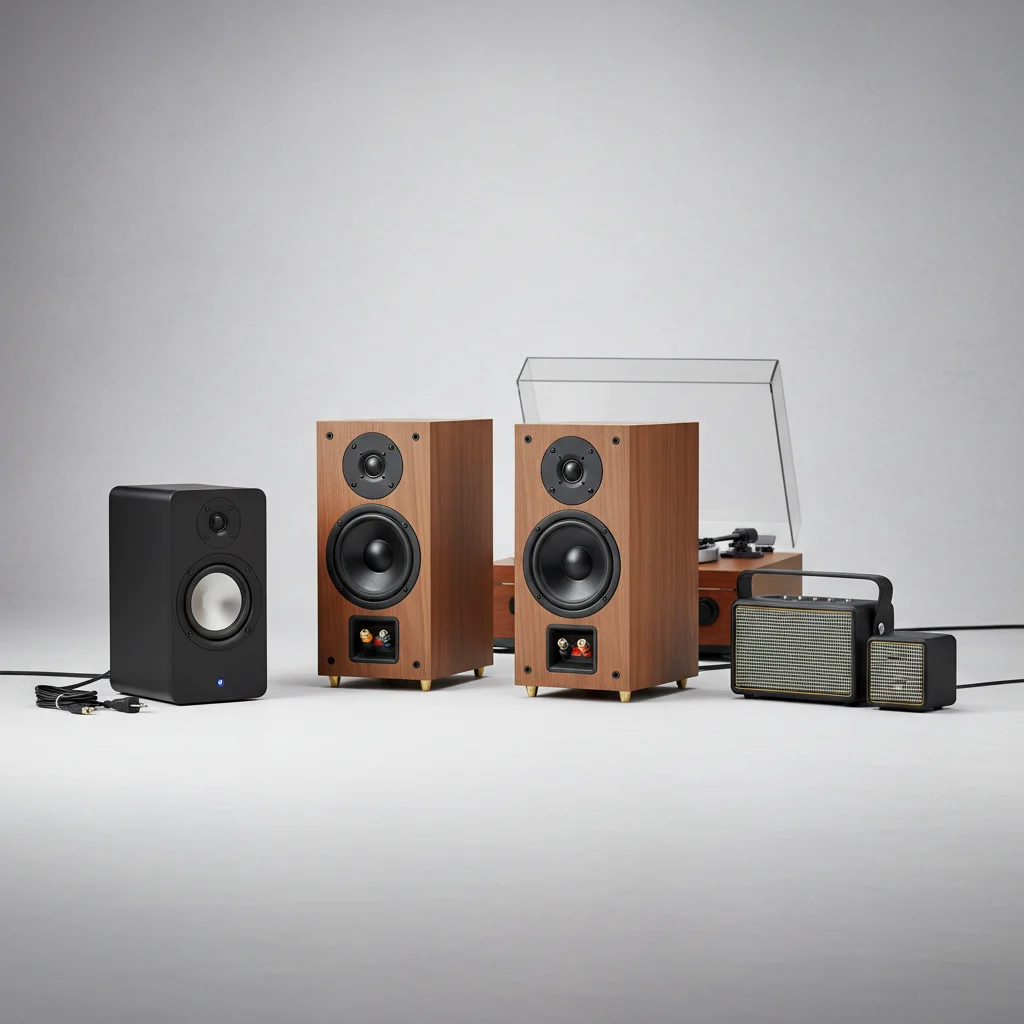
Choosing the right record player speakers involves selecting from three main types: passive, active, and powered speakers. Passive speakers require an external amplifier, offering maximum customization for audiophiles. Active speakers have built-in amplifiers for a simpler setup, while powered speakers specifically include a phono preamp, making them ideal for direct turntable connection. Each type offers distinct advantages depending on your audio preferences and setup requirements.
Understanding Passive Speakers for Turntables
Passive speakers necessitate an external amplifier or receiver for power. This configuration provides the most flexibility for audiophiles, enabling them to mix and match components to achieve a specific sound profile. You can pair high-quality passive speakers with a dedicated phono preamp and a powerful amplifier, creating a robust and customizable audio chain. This approach is often favored by those who enjoy fine-tuning their sound and upgrading individual components over time.
When selecting passive speakers, pay attention to their impedance (measured in ohms) and sensitivity (measured in dB). These specifications help ensure correct matching with an amplifier, preventing underpowering or overpowering, which can degrade sound quality or damage equipment. Many vintage setups utilize passive speakers, and they remain a popular choice for their sonic depth and upgrade potential.
Exploring Active Speakers for Record Players
Active speakers, also known as powered speakers, feature built-in amplifiers. This allows them to connect directly to your record player, provided your turntable has a built-in phono preamp or you use an external one. Active speakers offer a simpler, more compact setup, reducing cable clutter and the need for separate components. They are an excellent choice for beginners or those with limited space who still desire quality sound.
Many modern active speakers come with additional features like Bluetooth connectivity, allowing them to function as versatile audio systems for streaming music from other devices. While they offer less component-level customization than passive setups, their convenience and often impressive sound quality make them a compelling option for many vinyl enthusiasts.
The Role of Powered Speakers in a Turntable System
|
Our Picks for the Best Record Player in 2026
As an Amazon Associate I earn from qualifying purchases.
|
||
| Num | Product | Action |
|---|---|---|
| 1 | Vinyl Record Player 3-Speed Bluetooth Suitcase Portable Belt-Driven Record Player with Built-in Speakers RCA Line Out AUX in Headphone Jack Vintage Turntable |

|
| 2 | Vinyl Record Player Turntable with Built-in Bluetooth Receiver & 2 Stereo Speakers, 3 Speed 3 Size Portable Retro Record Player for Entertainment and Home Decoration |
|
| 3 | Audio-Technica AT-LP60X-BK Fully Automatic Belt-Drive Stereo Turntable, Black, Hi-Fi, 2 Speed, Dust Cover, Anti-Resonance, Die-Cast Aluminum Platter |
|
| 4 | Audio-Technica AT-LP60X-GM Fully Automatic Belt-Drive Stereo Turntable, Gunmetal/Black, Hi-Fidelity, Plays 33-1/3 and 45 RPM Vinyl Records, Dust Cover, Anti-Resonance, Die-Cast Aluminum Platter |
|
| 5 | SoulBox S1 Vinyl Record Player with Stereo Speakers, Turntable with Built-in Preamp, S-Shaped Tonearm, 33/45 RPM - Walnut |
|
| 6 | Vinyl Record Player with Dual Stereo Bookshelf Speakers Vintage Turntable with Bluetooth Wireless Playback Belt Drive 3-Speed Playback Record Player Support RCA Out Auto Stop |
|
| 7 | Vintage Record Player with External Speakers Belt-Drive Turntable for Vinyl Records Dual Stereo Speakers LP Players Support 3 Speed 3 Size Wireless Playback AUX Headphone Input Auto Stop Wood Red |
|
| 8 | Vinyl Record Player with Speakers Vintage Turntable for Vinyls Records Belt-Driven Turn Table Support 3-Speed, Wireless Playback, Headphone, AUX-in, RCA Line LP Phonograph for Sound Enjoyment Black |
|
| 9 | Victrola Journey Bluetooth Portable Suitcase Record Player – with Built-in Speakers, 3 Speed Vinyl Record Player, RCA Out, Headphone Jack (Smoky Blue) |
|
| 10 | Victrola The Quincy 6-in-1 Bluetooth Record Player & Multimedia Center with Built-in Speakers – 3-Speed Turntable, CD & Cassette Player, AM/FM Radio, Wireless Music Streaming (Mahogony) |
|
Powered speakers are a specific type of active speaker that often includes a phono preamp, making them ready to connect directly to most turntables without any additional equipment. This all-in-one solution is incredibly user-friendly and ideal for those seeking a plug-and-play experience. They significantly simplify the setup process, making it easy to start enjoying your vinyl collection right out of the box.
While the terms “active” and “powered” are sometimes used interchangeably, powered speakers specifically highlight the inclusion of a phono preamp, which is a key consideration for turntable users. They are designed to deliver a balanced and clear sound, often optimized for vinyl playback.
Key Considerations When Choosing Speakers
When making your decision, consider the size of your listening space, your budget, and your desired level of audio fidelity. Larger rooms may benefit from more powerful speakers, while smaller spaces might be better served by compact bookshelf models. Also, think about future upgrades; if you anticipate wanting to experiment with different amplifiers or preamps, a passive setup offers more flexibility.
Here are some essential factors to weigh:
- Sound Quality: Prioritize speakers that offer clear highs, rich mids, and defined bass.
- Connectivity: Ensure compatibility with your turntable and any other audio sources.
- Room Size: Match speaker power and size to your listening environment.
- Budget: Determine how much you’re willing to invest in your audio setup.
- Aesthetics: Choose speakers that complement your home decor.
Setting Up Your Record Player Speakers
Proper placement of your speakers can significantly impact sound quality. Generally, speakers should be placed at ear level and equidistant from your listening position, forming an equilateral triangle. Avoid placing them too close to walls, as this can cause bass buildup and muddy the sound. Experiment with toe-in (angling the speakers slightly inward) to find the sweet spot for your room.
Ensure all connections are secure and use high-quality cables to minimize signal loss. If you’re using passive speakers, make sure your amplifier’s wattage matches the speakers’ requirements. For active or powered speakers, simply connect them to your turntable and power source, and you’re ready to spin your favorite records.
Frequently Asked Questions
What are the main types of speakers for record players?
The three main types of speakers for record players are passive, active, and powered speakers. Passive speakers require an external amplifier, active speakers have built-in amplifiers, and powered speakers often include a phono preamp for direct turntable connection.
Do passive speakers need an amplifier to work with a turntable?
Yes, passive speakers always require an external amplifier or receiver to power them. This allows for greater customization of your audio chain, as you can select specific components like a phono preamp and amplifier to match your sound preferences.
What is the key difference between active and powered speakers?
While often used interchangeably, the key difference is that powered speakers specifically highlight the inclusion of a built-in phono preamp. This feature allows them to connect directly to most turntables without additional equipment, offering a plug-and-play experience.
How does room size affect speaker choice for a record player?
Room size significantly affects speaker choice because larger rooms generally benefit from more powerful speakers to fill the space adequately. Conversely, smaller rooms are often better served by compact bookshelf models, which can prevent bass buildup and muddy sound.
What factors should I consider when choosing speakers for my turntable?
When choosing speakers for your turntable, consider sound quality, connectivity options, the size of your listening room, your budget, and the aesthetic appeal. Prioritize clear highs, rich mids, and defined bass, and ensure compatibility with your existing turntable setup.
Setting Up Your Record Player Speakers for Optimal Sound
Properly setting up your record player speakers is crucial for achieving the best possible sound quality from your vinyl collection. Follow these steps to optimize placement and connections.
Place your speakers so that the tweeters are at ear level when you are in your primary listening position. This ensures that high-frequency sounds are directed accurately to your ears, improving clarity and detail.
Arrange your speakers and listening position to form an equilateral triangle. This setup creates an optimal soundstage, allowing for balanced stereo imaging and a more immersive listening experience. Measure the distance between speakers and to your listening spot for accuracy.
Keep speakers away from walls, especially in corners, to prevent excessive bass buildup. Placing speakers too close to reflective surfaces can cause muddy sound and an unbalanced frequency response. Experiment with distances of at least 6-12 inches from the wall.
Adjust the toe-in, which is the angle at which speakers are pointed inward towards the listening position. Small adjustments can significantly impact the soundstage and focus. Start with speakers pointing straight ahead and gradually angle them inward until you find the sweet spot.
Ensure all cables are securely connected between your turntable, amplifier (if using passive speakers), and speakers. Use high-quality cables to minimize signal loss and interference, which can degrade overall sound quality. Double-check that positive and negative terminals are correctly matched.

I was really hoping to find a good recommendation for powered speakers, since I’m trying to connect directly to my turntable. While the explanation of what they are was clear, I felt like there could have been more specific brand or model suggestions. It’s still a bit overwhelming trying to pick one out from all the options available. The phono preamp inclusion is definitely a plus though.
Finally, a clear explanation of the differences! I always got confused between active and powered speakers. Knowing that powered speakers specifically include a phono preamp makes so much sense for someone like me who just wants to plug in and play. My old system had so many wires, this simplifies everything and sounds great.
I’ve been looking to upgrade my setup for a while, and the breakdown of passive speakers really helped me make a decision. I love the idea of customizing my sound, so pairing some good passive speakers with a separate amp sounds like the way to go. My old all-in-one just wasn’t cutting it anymore for my growing vinyl collection. Thanks for the detailed info!
The info on active speakers was super helpful. I’m not a huge audiophile, but I wanted something better than my basic setup without a ton of extra components. The built-in amplifier is a game-changer for simplicity. I just got a new turntable and wanted to keep things clean and easy to use. Sound quality is pretty solid for the price too.