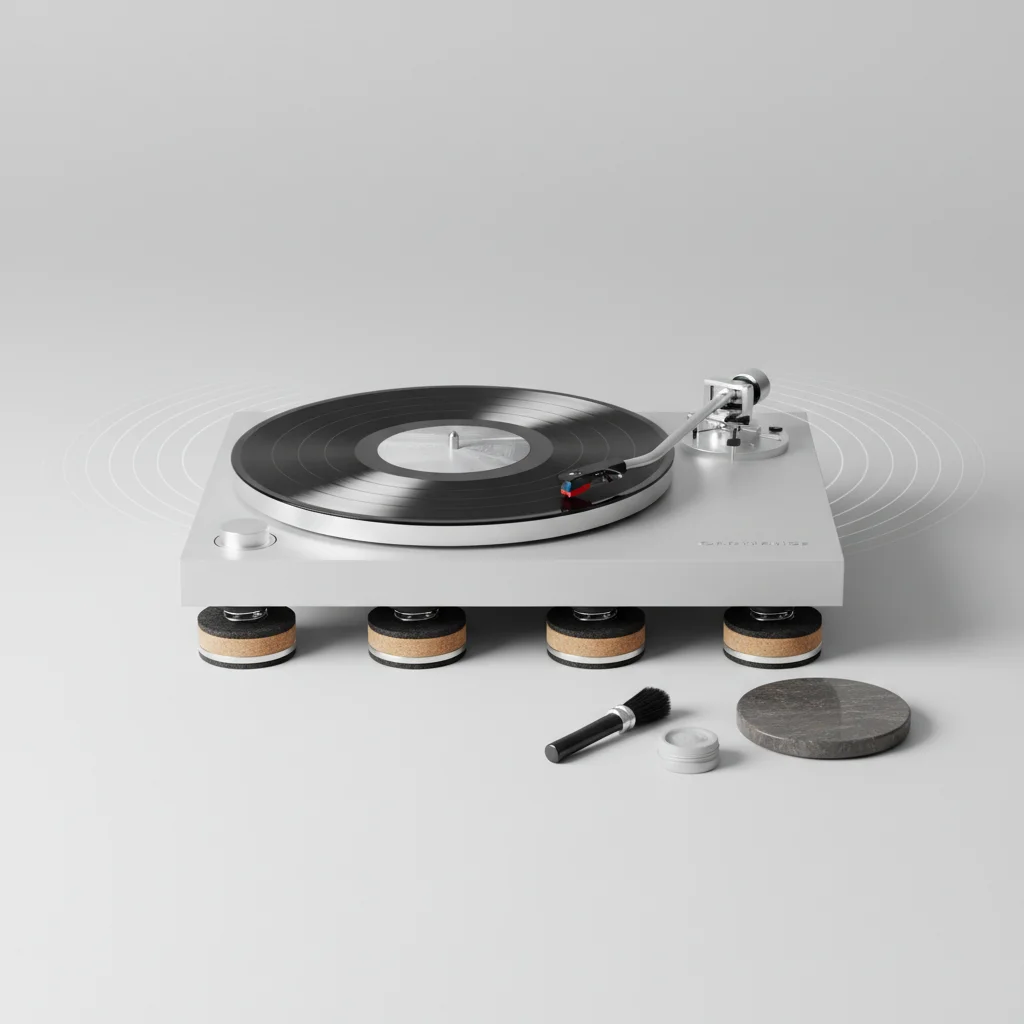
Record player vibration can significantly degrade sound quality, introducing unwanted noise and distortion. Minimizing these vibrations is crucial for any audiophile or casual listener seeking pristine audio playback. There are typically five main sources of vibration that can affect your record player, each requiring specific solutions to ensure your vinyl sounds its best.
Understanding the Sources of Record Player Vibration
Vibrations can originate from various external and internal sources. External vibrations often come from footfalls, speakers, or even traffic outside your home, traveling through the floor or furniture to your turntable. Internal vibrations, on the other hand, are generated by the record player’s motor or platter itself. Identifying the specific source is the first step in effectively mitigating the issue. For compare top record players on this site.
Isolation Feet and Platforms: Your First Line of Defense
One of the most effective ways to combat external vibrations is by using isolation feet or a dedicated isolation platform. These accessories are designed to decouple your record player from the surface it rests on, absorbing and dissipating vibrational energy before it reaches the sensitive stylus. High-quality isolation feet often incorporate materials like sorbothane, rubber, or springs to achieve optimal dampening.
Optimizing Speaker Placement to Reduce Resonance
Speakers are a common culprit for inducing vibrations, especially when placed on the same surface as your record player or too close to it. To minimize this, ensure your speakers are on separate, sturdy stands or shelves, ideally not directly connected to the turntable’s support. Experiment with speaker positioning, moving them further away from the record player, and consider using isolation pads under the speakers themselves to prevent sound energy from traveling through the floor or walls.
Addressing Motor and Platter Vibrations
|
Our Picks for the Best Record Player in 2026
As an Amazon Associate I earn from qualifying purchases.
|
||
| Num | Product | Action |
|---|---|---|
| 1 | Vintage Record Player with External Speakers Belt-Drive Turntable for Vinyl Records Dual Stereo Speakers LP Players Support 3 Speed 3 Size Wireless Playback AUX Headphone Input Auto Stop Wood Red |

|
| 2 | Victrola The Quincy 6-in-1 Bluetooth Record Player & Multimedia Center with Built-in Speakers – 3-Speed Turntable, CD & Cassette Player, AM/FM Radio, Wireless Music Streaming (Mahogony) |
|
| 3 | Audio-Technica AT-LP60X-BK Fully Automatic Belt-Drive Stereo Turntable, Black, Hi-Fi, 2 Speed, Dust Cover, Anti-Resonance, Die-Cast Aluminum Platter |
|
| 4 | Audio-Technica AT-LP60X-GM Fully Automatic Belt-Drive Stereo Turntable, Gunmetal/Black, Hi-Fidelity, Plays 33-1/3 and 45 RPM Vinyl Records, Dust Cover, Anti-Resonance, Die-Cast Aluminum Platter |
|
| 5 | Vinyl Record Player 3-Speed Bluetooth Suitcase Portable Belt-Driven Record Player with Built-in Speakers RCA Line Out AUX in Headphone Jack Vintage Turntable |
|
| 6 | Victrola Journey Bluetooth Portable Suitcase Record Player – with Built-in Speakers, 3 Speed Vinyl Record Player, RCA Out, Headphone Jack (Smoky Blue) |
|
| 7 | Vinyl Record Player Turntable with Built-in Bluetooth Receiver & 2 Stereo Speakers, 3 Speed 3 Size Portable Retro Record Player for Entertainment and Home Decoration |
|
| 8 | Vinyl Record Player with Speakers Vintage Turntable for Vinyls Records Belt-Driven Turn Table Support 3-Speed, Wireless Playback, Headphone, AUX-in, RCA Line LP Phonograph for Sound Enjoyment Black |
|
| 9 | SoulBox S1 Vinyl Record Player with Stereo Speakers, Turntable with Built-in Preamp, S-Shaped Tonearm, 33/45 RPM - Walnut |
|
| 10 | Vinyl Record Player with Dual Stereo Bookshelf Speakers Vintage Turntable with Bluetooth Wireless Playback Belt Drive 3-Speed Playback Record Player Support RCA Out Auto Stop |
|
Internal vibrations, particularly from the motor or platter, can be more challenging to address but are equally important. A well-maintained record player should have a smooth-running motor. If you notice excessive motor noise or vibration, it might indicate a need for lubrication, belt replacement, or even a motor adjustment. Heavier platters, often made from acrylic or metal alloys, inherently offer better dampening against internal resonances compared to lighter, less dense materials.
The Role of a Sturdy and Level Surface
The foundation your record player rests on plays a critical role in vibration control. A flimsy or uneven surface will amplify vibrations rather than absorb them. Always place your turntable on a heavy, rigid, and perfectly level surface. Wall-mounted shelves can be an excellent solution, as they often bypass floor-borne vibrations entirely. Ensure the shelf is securely anchored and can support the weight of your record player without flexing.
Regular Maintenance for Vibration Prevention
Consistent maintenance can prevent many vibration-related issues. Regularly check your record player’s belt for wear and tear, as a stretched or cracked belt can cause inconsistent platter rotation and introduce vibrations. Keep the platter bearing clean and lubricated according to the manufacturer’s recommendations. Also, ensure your tonearm is properly balanced and the anti-skate is correctly set, as an improperly adjusted tonearm can exacerbate vibrational effects on the stylus.
- Check and replace worn belts regularly.
- Lubricate platter bearings as per manufacturer guidelines.
- Ensure tonearm is perfectly balanced and anti-skate is set.
- Clean your stylus to prevent buildup that can amplify vibrations.
- Inspect all connections and cables for secure fit.
